Winter does not merely test your heating equipment; it fights a silent fight with your house’s first protection line: your siding. You might consider snow and icicles as simple surface issues, but actually, the major problem is moisture entering your home that is not easy to see. When siding cannot keep water outside its proper area, the result won’t be only aesthetic damage; rather, it will be decay of the structure, growth of mold, and insulation that has lost its ability to keep your home comfortable, which can stay with you for a long time even after spring has come.
Recognizing the indicators of siding failure in winter is very important because cold can speed up the process and reveal weaknesses that would otherwise remain hidden during the warm seasons.
Why Winter Exposes Siding Failures?
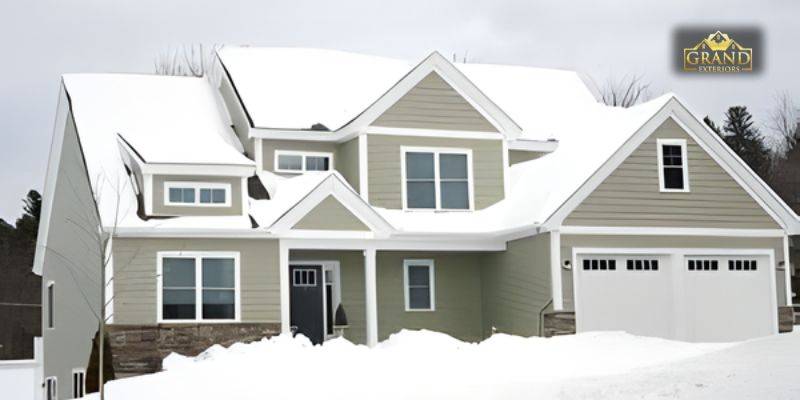
Moisture intrusion during winter is a big issue, especially because of the freeze-thaw cycles. Water that infiltrates behind the siding not only freezes, thus expanding and opening small gaps even more, but also loosens the panels, hence leading to the formation of new ways for more moisture to get in. The same cycle occurs with every change in temperature, changing minor issues into major failures. Besides, the ice dams at the roof edge can push the meltwater under the roofing materials and behind the siding, whereas the wind and snow drive moisture into any existing weakness.
Being able to tell the signs of trouble early could lead one to a simple repair rather than a total siding replacement.
The Visible Warning Signs: What to Look For
1. Warped, Swelling or Warping Panels
How it Appears: Panels of siding that seem to have bulges, bends, or become loosened from the wall surface. Vinyl siding will often appear wavy; whereas vinyl will often show raised grain patterns on the surface of the wooden siding.
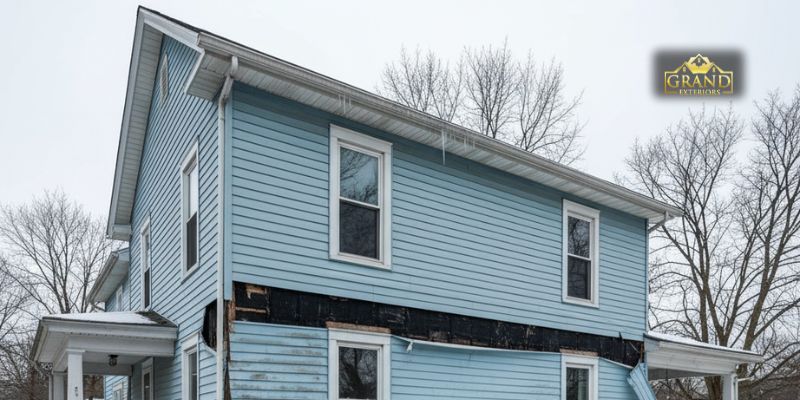
What it is Indicating: Through water penetration into the back side of the siding product(s), the products have experienced deformation (therefore compounded), and the materials on the back edge of the siding product(s) have (or could) most likely been exposed to moisture resulting in rotting of the (usually) wood substrate (the substrate is normally wood sheathing the backside surface of the siding material).
2. Soft Spot or Sponginess
How it Feels: When buttressed by reasonable pressure (i.e., with a finger or screwdriver handle) on the surface of the siding, the siding will also compress/mush, and this feature is primarily associated with wood, engineered wood, and/or fiber cement fine-grained products.
What it is Indicating: The material has absorbed too much moisture, and the product is rotting. It is also considered one of the most critical points of failure.
3. Continuous Mold, Mildew, or Other Fungus Growth
How it Appears: Black streaks, dark (and/or green) stains, and fuzzy white growth occur quickly after cleaning (especially in shaded and/or north-facing areas).
What it is Indicating: There is an excessive amount of moisture that is either contained behind the siding product or retained in moisture on the exterior of the product. Mold on the exterior of a wall indicates likely moisture has been accumulating internally in the wall cavity.
4. Visible Space between Panels (Gaps or Cracks) or Loose Paneling
What to Expect: Large gaps in the siding where one panel meets another at the corners and/or around the body trim on any wall of the house. You may be able to see daylight coming through the gaps into your attic or basement area.
What it indicates: This type of problem is caused when the siding system has lost its integrity due to exposure to the elements through extreme weather conditions, shifting due to the weight of the home on its foundation, or poor installation processes, thus providing an open passage for wind-driven rain or snow to enter the siding system.
Common Sources of Moisture Intrusion – The Hidden Perpetrators.
Even if your siding appears to be in good shape, moisture intrusion may occur due to other issues you don’t see:
- Failed or Missing Caulking: Wherever there is a joint between your siding and any other surface (such as trim), the caulk is the primary method of moisture prevention. If the caulk is cracked or missing, moisture is going to enter.
- Damaged or Improperly Installed Flashing: Flashing is used in several places to direct water away from siding; those places are roof-to-wall connections, windows, and kickouts (i.e., the bottom edge of a roof extending down); water will enter through damaged or improperly installed flashing.
- Clogged or Improperly Installed Weep Holes: Certain siding systems, such as brick and several panel systems, need weep holes to permit trapped moisture to ventilate out from behind the siding; if weep holes are clogged with dirt or have been painted over, then it would be impossible for trapped moisture to escape.
- Improper Landscaping or Watering Issues: Soil or mulch stacked against the siding or constant watering of the siding with sprinkler systems creates a consistent wetting condition for the siding.
A Guide to Safeguarding Your Winter Siding
Immediate Action Steps
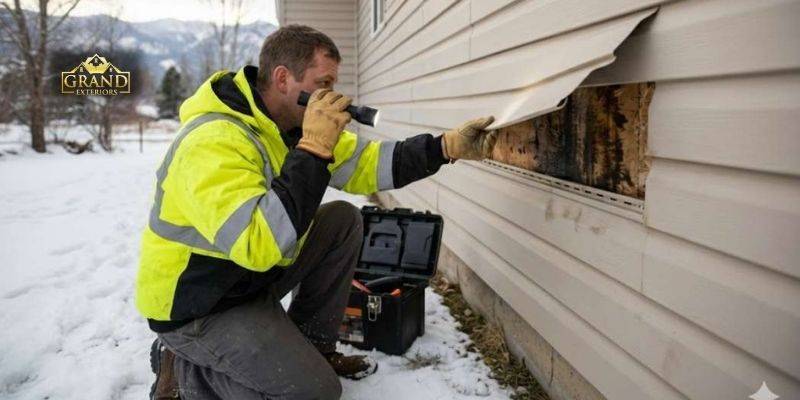
- Complete Visual Inspection – On a bright day (using binoculars may be useful), go outside and check near and around your house for any signs of the previously mentioned damage.
- Attic/Basement Inspection – From the house’s interior, illuminate your exterior walls’ backs with a flashlight and search for any moisture stains or mold indications.
- Remove More Snow & Ice – Use caution when removing snow piles away from the same area of your siding until they have melted. You should always allow between 12 and 18 inches between your siding and snow piles to reduce the length of time your siding has contact with any additional moisture.
- Clean Your Gutters/Downspouts – Be sure that they are diverting water at least five feet away from your foundation and siding.
When a Professional Should Be Called:
- If a lot of soft areas or huge damage are discovered.
- If there are interior indicators that match exterior problems.
- When your roof has ice dams again and again.
- When you think that there is a huge installation failure (such as poor flashing).
A skilled siding contractor can carry out a moisture meter test to find out about concealed wetness in walls without the need for making any destructive demolition.
Conclusion:
Siding provides more than just an attractive external appearance to your property. It serves as an essential part of your house’s weatherproof system. Notably, moisture that penetrates your home due to poor sliding performance during winter months is much more than just a minor issue. It develops into an ever-growing process that continues to create structural damage, health risks to occupants, and declines in energy efficiency throughout your house.
Don’t put off inspecting your siding this winter; do so sooner rather than later. A small bubble or streaky area on your home’s exterior may indicate that you need to consider whether your siding has failed and how that may impact you and your family. Early detection of an issue with your siding can prevent issues from becoming more serious, not only for the exterior of your home, but more importantly for everything and everyone inside your home.
Be aware that if you think you may have an issue with your home’s siding, obtaining a professional opinion will be lower in cost than repairing rotted walls, replacing insulation, or obtaining professional assistance for remediation of mold growth.