Winter isn’t solely responsible for causing damage to a house. More often than not, the most damaging factor is an almost silent, continuous, and barely perceptible thing happening on the house’s outside: the freeze-thaw cycle. This inexorable force of nature is like a hammer in slow-motion.
Figuring out the whole process is the first thing you need to do in order to secure your house against it. And more than that, understanding the ways in which the professionals fight it tells you why their skills are an all-important investment in the immortality of your property.
Here’s how the destructive cycle works:
The infiltrating stage is when rain or a thaw (winter) causes water to get into the microscopic pores, cracks, and seams that are present on the surface of your siding materials.
After invading your siding materials with moisture, the water then expands. When temperatures fall below freezing, water cannot escape, and therefore begins to freeze inside the cracks and microscopic pores in your siding materials. Since water expands 9% when converting from water to ice, this additional pressure creates significant amounts of pressure from within your siding material.
The water that has been trapped inside your siding will expand and this will cause the formation of cracks and openings in the siding materials, as a result of the pressure building up from within the material.
In this case, the cycle of repeated freeze and thaw will again recur. The first thaw will cause the previously frozen water to melt and thus, water will be able to penetrate your siding materials even more, now reaching deeper into the layers of the already cracked siding materials. This process will go on and over time, the repeated freezing and thawing will continue to break up the material.
The pressure might cause the outer layer to “spall” or peel off. In the case of bricks, it could also weaken the mortar joints between the bricks; this is known as mortar joint failure.
The Professional’s Playbook: A Multi-Layered Defense Strategy:
The professional expertise is the one that changes the fight. When a trained professional installer installs siding, he not only attach panels to the house; he executes on the very house a complete moisture handling and expansion-contraction control system.
1. The Foundation: Flashing and Weather-Resistive Barriers (WRB)
First thing in the morning, the very first person you see is the installer who puts the siding and he is ready to work on the “raincoat” for your house.
Flashing: This is the meticulous process of applying non-corrosive metal (usually aluminum or galvanized steel) to all possible water entrance points—windows, doors, and corners. The way it is shaped and put makes it possible for the water to flow away from the house’s most exposed spots.
The WRB (House Wrap): Over the sheathing, a top-notch wrapping material is spread. The aim of this barrier is to be water-repellent and at the same time, permit vapor of moisture that has been accidentally trapped behind the siding to escape while repelling considerable water entry.
2. The Art of Installation: Considering Movement
Siding is an issue the experts understand as a process of both respiration and motion.
Nailing Techniques: Siding is never completely secured. Fasteners of all types (vinyl, fiber cement, or wood) are done with a very tiny gap (nearly the thickness of a dime) to allow siding to lose or gain moisture without creating bulges or cracks.
Planned Gapping: Expansion joints are purposely created at equal distances, especially on wide siding runs. The gaps are covered by the trim and are essential for managing heat movement in a way that does not lead to destruction.
Proper Overlaps and Seams: The overlap of laps and the sealing of seams are done with water drainage as the main concern, thus ensuring that water flows down and away from the house, not into the wall cavity.
3. The Last Barrier: High-Quality Caulking and Sealants
Professional opinion is that the premium quality sealants are only the ones that are used in the most extreme outdoor applications. These are the types of products that, despite the severe temperature shifts, do not lose their properties and, at the same time, do an excellent job in sealing the cracks around windows, doors, and trim without breaking. And where low-grade caulk is used at such points, the freeze-thaw cycle has already begun its destructive work.
The Preventive Measure: Benefits of a Professional Inspection
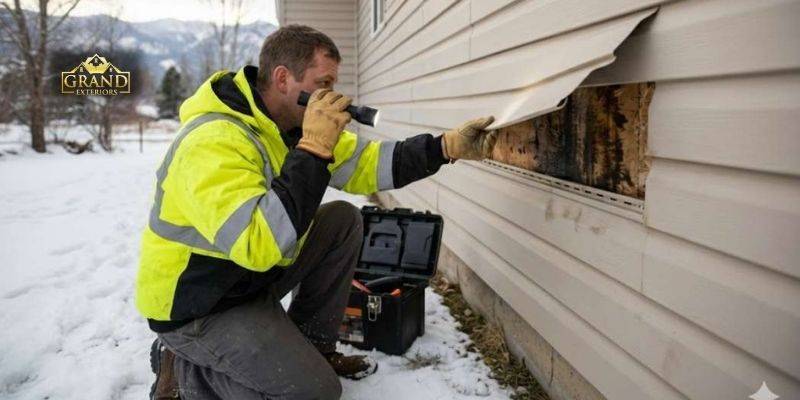
The most effective way to deal with a difficulty is to take it as an opportunity. A professional siding contractor can provide your home with a pre-winter assessment that will reveal its strong and weak points, along with the areas of concern, before they escalate into major issues.
They will check for:
Discolored and cracked caulk
Siding panels that are loose or missing
Flashing that is damaged or rusted
Moisture behind the siding
The Bottom Line: An Investment in Preservation
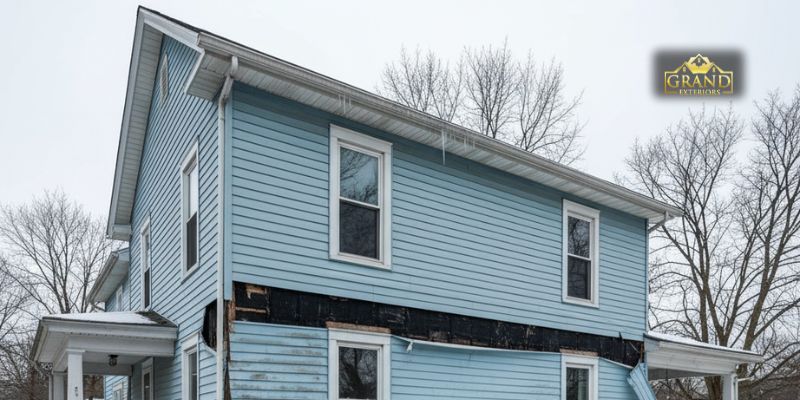
The problems caused by the freeze-thaw cycles are gradual and unnoticeable. The next thing you realize a small crack has turned into a major leak and a considerable, financially draining repair after a few winters.
It is not only about the materials when hiring a specialist to put in or take care of your siding; it is about investing in a complete system—a carefully developed moisture management strategy that knows and fights the constant physics of winter. If you put your trust in a professional, you are not only mending the outer layer of your house, but you are also making the house stronger against the silent, cyclic attack of the seasons, thus ensuring that it will be nice-looking and covered for many years.